

Dear readers,
As mentioned last week, I would like to not only share my poems with you, but also provide more elements of analysis, storytelling the creative process behind each piece.
If you missed the poem, you can read it again here: Astra
Astra is an older poem, composed at the beginning of 2023.
At that time, I was still searching for the tone that would define my style. Although I don’t particularly like to confine myself to a category or label, I must admit that my tendency has evolved toward a more striking style, raw and direct, adopting a freer approach.
But let’s focus on this particular piece: as you’ve probably guessed, the star of this poem is the sun.
The inspiration came to me on an unusually warm winter day. As I was tapping on my keyboard, I noticed how bright the light was, even though these months were usually quite gray.
This vision brought a smile to my face, which pushed me to write the first lines. Being passionate about mythology (Greek, in this case), I made a small nod to the realm of the gods, as well as Helios and his chariot. This mythological element becomes important in the last stanza of the poem.
Although the first two stanzas might seem like an ode, certain elements already point to the real theme behind the text: climate change.
“Before the curse”
“While fire shrouds the greed in which we’re raised”
Once again, the day was unusually warm for this time of year, and I couldn’t help but think back to certain moments in my childhood, when snow used to cover the ground at this season.
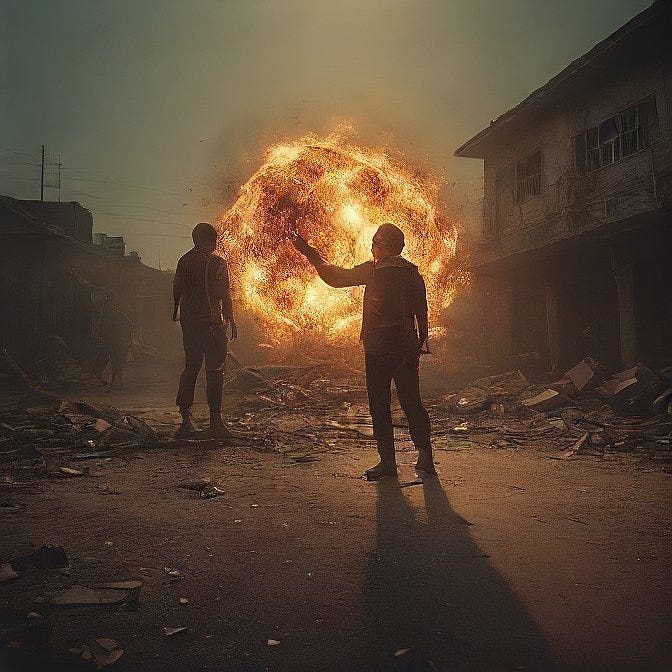
The following stanzas highlight human involvement in global warming. Everyone knows what is happening, yet we can only stand in awe at the desolate spectacle: a vision of the Earth gradually dying, illustrated by the “black smoke in flight” rising from “the burning castle.”
The final stanza is an invitation to reflect on our position regarding creation and, inevitably, our conception of deity or deities.
Here, we see a duality: on one hand, the mythological aspect; on the other, a form of paradigm shift.
Mythology often serves to provide explanations through the intervention of divine will. In this case, humans are aware of the destruction of their environment because they are the driving force behind it. This stanza highlights a form of denial of the divine (“rebellion of mankind against its sires”), as humans are conscious that they can be responsible for their own eradication and knowingly choose to act against their creator. They refuse to refer to one or more gods to justify their existence, entering a new era in which humanity deliberately defies its creators.
Two subtleties to note before your comments:
A nod to Tolkien in the phrase “The Valar’s lamps at night”, referencing a Silmarillion episode
The phrase “black smoke in flight”, just before the castle allegory, emphasizes one of the main causes of global warming: toxic industrial smoke.
And you—what feelings or thoughts did this poem evoke for you? Which images or ideas stood out, and how do you interpret the story behind “Astra”?
Peace & Bliss,
Aaron
I really enjoyed reading this. It helps to understand how much thought goes into a poem.
I love how you use mythology.